Bunny and Bunny Junior’s sales trip
The Death of Bunny MunroBunny and Bunny Junior’s sales trip is both a working route and an unstable father-and-son journey. Bunny presents the road as a place where he can resume selling and teach his son, but the trip’s direction changes: after a scheduled customer stop, he announces that they are going to visit his father. Later, he performs his salesman identity before a group of women and sends Bunny Junior to wait at a swimming pool. These shifts make the journey’s practical business purpose inseparable from Bunny’s attempts to define his role as a father and as a salesman.
Departure and the lesson of patience
The trip’s return to the road is marked by Bunny’s excitement. As he starts the car and pulls into traffic, he celebrates Bunny Junior’s intelligence and his own renewed freedom of movement. His exuberance is physical and conspicuous: he adjusts his clothes while cars sound their horns around them. The scene establishes the road not just as a route between customers, but as the setting in which Bunny intends to resume his familiar, performative confidence.
On the Brighton Road, he begins instructing Bunny Junior in the first principle of salesmanship: patience. The lesson gives the journey an explicit father-to-son purpose. Bunny is not simply taking his son along while he works; he casts the trip as an apprenticeship, with himself as the authority who can pass on a professional rule. Yet the rule also sits in tension with his own hurried, exuberant driving and abrupt decisions. Patience is presented as essential to selling, while the trip itself will not follow a steadily controlled course.
The coastal route and its last listed customer
One stop is the bungalow of Miss Mary Armstrong, described as the final name on Bunny’s list. It stands on a hill between Peacehaven and Newhaven, and its overgrown yard is crowded with discarded household appliances, broken machines, old newspapers, a damaged kayak, a ruined settee, and a dismantled motorcycle. In the middle of this clutter is a welded-steel sculpture assembled with brightly painted strips of plastic. The account identifies the location and the customer’s place on the list, but does not describe a completed sale there.
The stop gives the journey a concrete itinerary: Bunny has customers to reach, and the list has an endpoint. Its setting contrasts sharply with the polished promise implied by selling beauty products. The yard is filled with objects whose former uses have been lost or abandoned; the visit therefore places Bunny’s commercial work amid visible disorder without establishing what Miss Mary Armstrong thinks of him or whether she buys anything. The finality of her position on the list matters because Bunny soon names a destination that is not a customer at all.
A change of destination
Bunny tells Bunny Junior that they are going to see his grandfather, identifying him as his own father and naming him as Bunny Munro Senior. He then accelerates away into the early-afternoon traffic on the coastal road. The announcement makes the family visit an immediate objective, rather than merely another lesson or sales call. The trip’s route has turned toward Bunny’s past and his relationship with his father, although the available moments do not explain why he chooses to go there at that point or what he expects to happen.
That redirection also changes the terms of Bunny’s authority over his son. At the beginning, he explains how a salesman should behave; here, he decides where the two of them are going and states the decision emphatically. The movement away from the listed customer route does not erase the sales trip, but interrupts its logic. Work, instruction, and family obligation occupy the same journey, without a clear boundary between them.
The salesman’s public performance
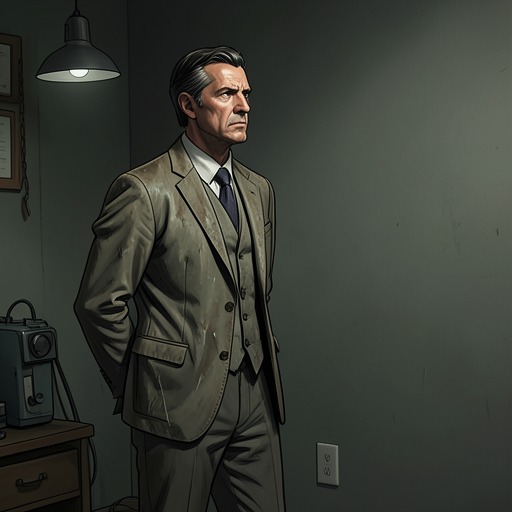
In a later encounter, Bunny gets out of the Punto and approaches three women seated among plastic tables and chairs with cigarettes and cappuccinos. His clothes and bearing suggest that his confident presentation has deteriorated: his hairstyle is disordered, and he tugs at a tie patterned with dead rabbits. He nevertheless introduces himself as Bunny Munro, identifies himself as a salesman, and states that he sells beauty products. The performance is direct and recognizable, but its setting and his appearance make the claim of professional composure uneasy.
The contrast recalls the earlier lesson about patience and the trip’s opening celebration of being back on the road. Bunny can still name his occupation and address prospective customers, but the scene shows his sales persona under strain rather than presenting an account of a successful pitch. The dead-rabbit tie also brings the trip’s recurring rabbit imagery into the visible details of his working clothes; here it is part of his appearance, not evidence of a new sales strategy or of how the women respond.
The swimming-pool separation
Bunny eventually tells Bunny Junior to wait for him at the swimming pool, saying that he will come and collect him later. The instruction separates them temporarily and gives the child a specific place to wait, while leaving Bunny’s next actions and the length of the separation unstated. It is a practical arrangement on the surface, but it also marks a change from the opening image of father and son sharing the road and from Bunny’s promise to teach his son the craft of selling.
Taken together, the trip’s documented moments move between shared travel, instruction, a listed customer, a visit to Bunny’s father, and a final separation at the pool. The sales route supplies the journey with an itinerary, but it does not contain Bunny’s decisions: he redirects the car toward his family history and later leaves Bunny Junior waiting while he attends to something else. The trip’s significance lies in that unsettled combination. Bunny tries to occupy the roles of salesman, teacher, and father at once, while the route repeatedly exposes the distance between declaring those roles and sustaining a shared journey.